
Choosing lighting for a modern interior is not simply about how bright a fixture is. The right
lighting should complement the architecture, highlight materials, create visual comfort and
enhance the overall experience of a space.
This is where the COB LED vs LED comparison becomes relevant. While both are LED-based
technologies, they can create very different lighting effects depending on the fixture, optics and
application.
For contemporary residential, commercial and hospitality interiors, COB LED lighting is often
preferred when precision, clean illumination and architectural detailing are important.
What Is COB LED Lighting?
COB stands for Chip on Board, a technology where multiple LED chips are mounted closely
together on a single substrate. This creates a compact light source that can produce a
concentrated and consistent beam.
COB LED lights are particularly useful for applications where light needs to be directed towards
a specific area rather than spread uniformly across an entire room.
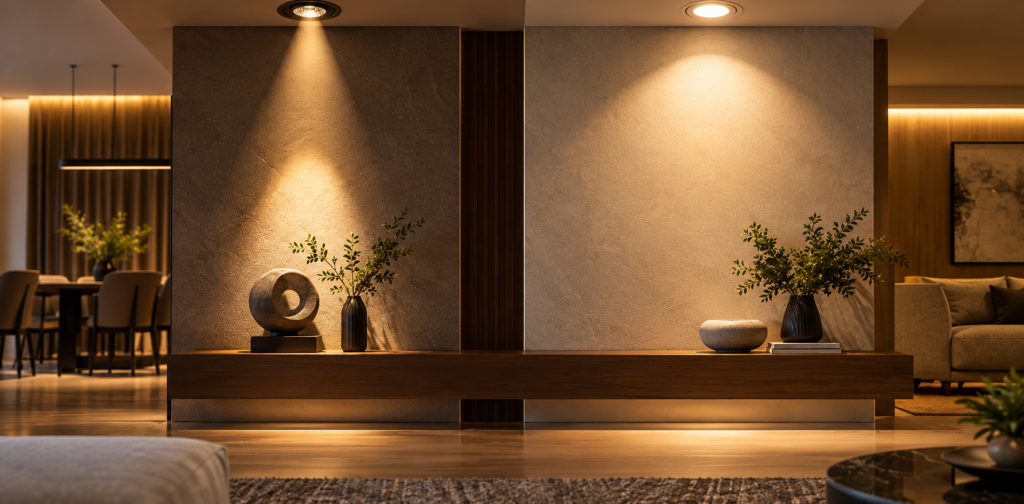
A COB LED downlight, for example, can be used to highlight artwork, furniture, textured walls,
display areas or architectural features.
COB LED vs Traditional LED: What Is the Difference?
The key difference is how the light is produced and distributed.
Traditional LED fixtures can provide broad, uniform illumination and are available in formats
such as panels, bulbs, strips and downlights. COB technology, on the other hand, is especially
suited to focused and directional lighting.
Feature COB LED Traditional LED
Light distribution Focused and directional Often broader
Accent lighting Excellent Depends on fixture
Architectural applications Highly suitable Suitable
General illumination Suitable with the right fixture Excellent
Beam control Strong Fixture dependent
Design applications Feature and accent lighting General and task
lighting
However, technology alone doesn’t determine performance. The fixture’s optics, beam angle,
driver, heat management and installation all have a major impact on the final result.
Key COB Lighting Benefits
Focused and Precise Illumination
One of the main COB lighting benefits is its ability to deliver concentrated light.
This makes COB particularly useful for highlighting:
● Artwork and sculptures
● Feature walls
● Decorative surfaces
● Dining areas
● Retail displays
● Architectural details
● Furniture and product displays
Instead of illuminating everything equally, focused lighting helps direct attention to the elements
that matter.
Clean Look for Modern Interiors
Minimalist interiors often require lighting that blends into the architecture rather than becoming
the focal point itself.
Compact COB fixtures can provide controlled illumination while maintaining a clean ceiling
appearance. This makes them well suited to contemporary homes, luxury retail spaces,
restaurants, hotels and premium offices.
Better Accent Lighting
Good interior lighting is rarely about using the same fixture everywhere.
A well-designed space combines ambient, task and accent lighting. COB LED lights can play an
important role in the accent layer by creating focused beams that add depth and definition to the
interior.
This is particularly relevant to architectural LED lighting, where the objective is to integrate
lighting with the architecture and materials of the space.
Where Traditional LED Lighting Works Better
COB is not automatically the better choice for every application.
Large spaces that require broad and consistent illumination may benefit from conventional LED
fixtures. Offices, kitchens, corridors and other functional areas often require uniform lighting
rather than concentrated beams.
This is why the question shouldn’t simply be, “Is COB better than LED?”
The better question is:
What does the space need the lighting to accomplish?
For general illumination, traditional LED can be highly effective. For focused architectural and
accent applications, COB can offer greater control.
COB LED vs LED for Modern Interior Design
Different spaces require different lighting strategies.
Residential Interiors
In living rooms, COB LED downlights can highlight artwork, walls or furniture, while broader LED
fixtures provide ambient illumination.
Bedrooms can benefit from softer, controlled lighting, particularly around wardrobes,
headboards and architectural features.
Commercial and Retail Spaces
Retail environments often use lighting to draw attention to products and displays. COB LED
lighting can provide focused illumination while maintaining a sophisticated visual environment.
Hospitality Spaces
Hotels, restaurants and luxury hospitality environments typically need several layers of lighting.
COB fixtures can create accents and focal points, while other LED solutions provide ambient
and functional illumination.
How to Choose the Best LED Lighting
When selecting the best LED lighting for an interior, don’t look only at wattage or the word
“COB.”
Consider:
● Required brightness and lumen output
● Beam angle
● Colour temperature
● Glare control
● Ceiling height
● Surface and material finishes
● Fixture placement
● Overall lighting design
A well-designed lighting system uses these factors together.
A high-quality fixture installed incorrectly can produce a poor result, while the right fixture,
positioned correctly, can completely transform an interior.
COB LED vs LED: Which One Should You Choose?
There is no single solution for every space.
COB LED lighting is particularly suitable when you need focused beams, accent illumination
and architectural detailing. Traditional LED fixtures can be more appropriate when broad,
uniform illumination is the priority.
For modern interiors, the best approach is often a combination of both.
The goal should not be to simply add more lights. It should be to create the right balance of
ambient, task and accent lighting so that the architecture, materials and interiors work
together.
At Casa De Mirdad, lighting is approached as part of the overall design, not just as a source of
illumination. The right lighting solution should enhance the space, highlight its details and create
an experience that feels intentional.