
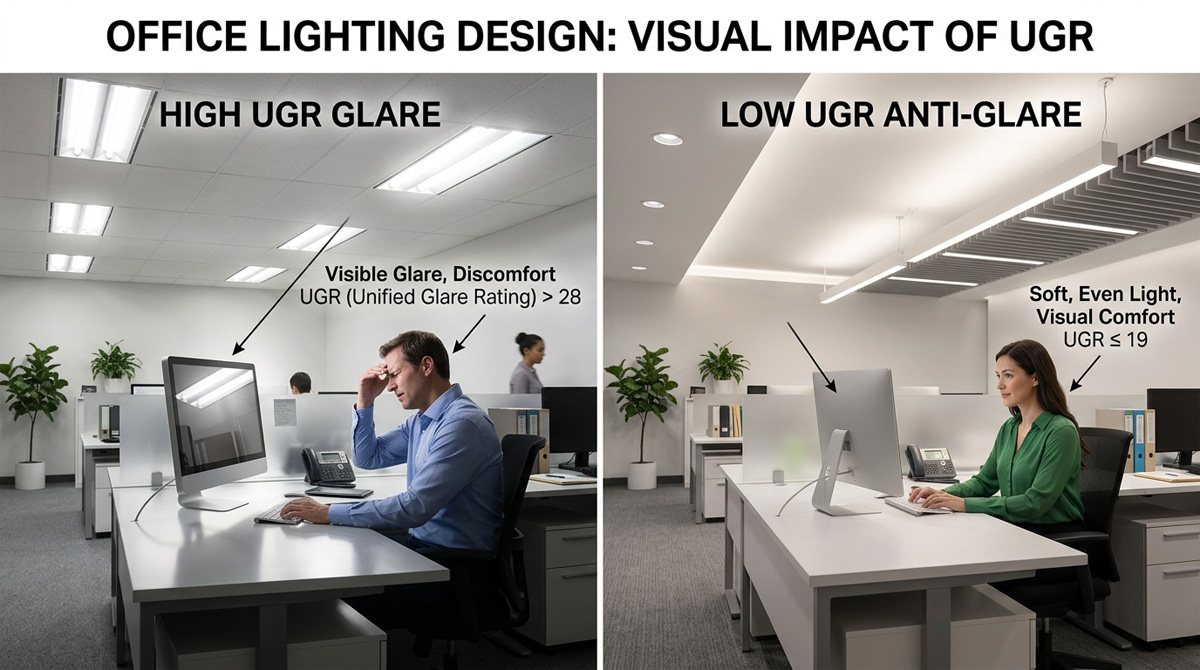
Lighting is not only about making a space bright enough to see. The quality, direction, intensity, and distribution of light can significantly influence how comfortable a space feels. This becomes especially important in offices, commercial spaces, educational institutions, healthcare environments, and other interiors where people spend several hours working or concentrating.
One of the important concepts used by lighting professionals to understand visual comfort is UGR, or Unified Glare Rating. UGR lighting helps evaluate the level of discomfort glare produced by lighting installations in an interior space. Understanding UGR can help architects, interior designers, lighting consultants, and property owners make better decisions when planning comfortable and functional environments.
For Casa De Mirdad, understanding concepts such as UGR is an important part of developing lighting solutions that balance aesthetics, functionality, and human comfort.
What Is UGR in Lighting?
UGR stands for Unified Glare Rating. It is a method used to assess discomfort glare caused by indoor lighting systems. Rather than simply measuring how bright a light source is, UGR considers how the light appears to people within a particular environment.
In simple terms, UGR helps answer an important question: Is the lighting comfortable to look at, or is it creating excessive glare?
The unified glare rating is expressed as a numerical value. Generally, a lower UGR indicates less discomfort glare, while a higher value indicates greater potential for glare.
This makes UGR particularly useful when planning lighting for environments where people need to read, work on computers, study, analyse information, or perform visually demanding tasks.
Why Does Glare Matter?
Glare occurs when there is excessive brightness or a significant difference in brightness within a person’s field of view. A bright light source positioned directly within someone’s line of sight can be uncomfortable, even when the overall illumination level in the room is appropriate.
Glare can affect how people experience a space. In workplaces, excessive glare may make computer screens difficult to view and can cause visual discomfort during extended periods of work.
The problem is not always that the room is too bright. A lighting installation can provide sufficient illumination while still creating uncomfortable glare because of the position, intensity, size, or distribution of the light sources.
This is why professional lighting design considers both illumination and visual comfort.
How Is UGR Calculated?
UGR is influenced by several factors within a lighting environment. The calculation takes into account the brightness of the luminaires, their position relative to the observer, the number of luminaires within the field of view, and the reflective characteristics of the surrounding surfaces.
The appearance of a luminaire can therefore change depending on where a person is standing or sitting.
For example, a light fixture that appears comfortable from one position may produce noticeable glare when viewed from another angle. This is particularly relevant in offices where people sit at desks and look at computer screens for long periods.
The calculation of unified glare rating is therefore more comprehensive than simply looking at the brightness of an individual lamp.
Understanding UGR Values
UGR values are generally used to compare the potential discomfort glare of different lighting arrangements.
A lower UGR value generally represents a more comfortable lighting environment, while a higher value indicates greater potential for discomfort glare.
Common UGR values used in lighting discussions include UGR 16, UGR 19, UGR 22, and UGR 25. The appropriate value depends on the type of space and the visual tasks being performed.
For example, spaces involving detailed visual work may require tighter control of glare than areas where people perform less visually demanding activities.
It is important to remember that UGR is not a universal measure of whether a lighting installation is good or bad. It is a specific metric that forms part of a broader lighting design approach.
UGR and Office Lighting
Office lighting is one of the areas where UGR is particularly important. Employees often spend several hours working with computers, documents, and other visual displays.
Poorly positioned luminaires can create reflections on screens or produce bright sources within a person’s direct field of vision. Over time, this can make the workspace feel uncomfortable.
Good office lighting should provide adequate illumination for tasks while controlling glare and maintaining a balanced visual environment.
Lighting designers may consider several factors when planning an office, including luminaire positioning, ceiling height, desk arrangement, surface reflectance, light distribution, and the type of visual tasks being performed.
The goal is not simply to install brighter lights. Instead, the objective is to create a lighting environment that supports concentration and comfortable visual performance.
What Is Discomfort Glare?
Discomfort glare refers to a sensation of visual discomfort caused by excessive brightness or contrast within the field of view. It does not necessarily prevent a person from seeing, but it can make the environment feel unpleasant.
For example, imagine sitting at a desk while a bright ceiling fixture is directly within your line of sight. Even if you can continue working, you may find yourself wanting to look away from the light.
This is an example of why glare control matters.
Discomfort glare can result from direct light sources, reflections, bright windows, poorly positioned luminaires, or excessive contrast between different areas of a room.
Direct Glare and Reflected Glare
Glare can generally be experienced in different ways.
Direct glare occurs when a bright light source is directly visible to the observer. A poorly positioned ceiling luminaire can be a common example.
Reflected glare occurs when light reflects from a surface into the observer’s eyes. In an office, reflections on computer screens or glossy desks can contribute to this problem.
Both forms of glare should be considered during the design process.
A professional lighting consultant can assess the relationship between light sources, furniture, architectural surfaces, windows, and user positions to create a more comfortable environment.
Can Lighting Be Completely Glare Free?
The phrase glare free lighting is often used when discussing comfortable lighting solutions. However, in practical lighting design, completely eliminating every possible source of glare is not always realistic.
Instead, professional lighting aims to control discomfort glare and create an environment where light is comfortable for the intended activities.
The objective of glare free lighting is therefore better understood as effective glare management. This can involve choosing appropriate luminaires, controlling brightness, adjusting beam angles, using diffusers, and carefully positioning fixtures.
The surrounding architecture also plays an important role. Wall colours, ceiling finishes, flooring, furniture, and other surfaces can influence how light is reflected throughout a space.
How Luminaire Design Affects UGR
The design of a luminaire can have a significant impact on glare.
A fixture with an exposed bright light source may create more visual discomfort than a fixture designed to shield or diffuse the light source.
Optical systems, diffusers, reflectors, louvers, and other components can be used to control how light leaves a luminaire.
For example, a luminaire designed with effective glare control may direct light toward the required working area while limiting the amount of intense light visible from typical viewing angles.
This is one reason why selecting lighting fixtures based solely on appearance or brightness may not produce the desired result.
UGR Is Not the Same as Brightness
One common misunderstanding is that a higher brightness automatically means a higher UGR. The relationship is more complicated.
UGR depends on the luminance of the luminaires, their position, their size, the observer’s location, and the surrounding environment.
A bright luminaire can potentially produce low discomfort glare if it is designed and positioned appropriately. Similarly, a moderately bright fixture can cause discomfort if it is positioned directly within someone’s field of view.
This distinction is particularly important when planning UGR lighting for professional environments.
The Role of Lighting Layout
The placement of luminaires is just as important as the fixtures themselves.
A well designed lighting layout considers the location of desks, workstations, meeting areas, walkways, screens, windows, and other elements within a space.
In an office, for example, ceiling fixtures should be positioned with consideration for desk orientation and computer screens. Simply arranging fixtures in a regular grid without considering the actual use of the space may not provide the best visual environment.
Lighting designers therefore look at the complete space rather than evaluating individual fixtures in isolation.
UGR and Human Centric Lighting
Modern lighting design increasingly considers how people experience spaces rather than focusing exclusively on technical illumination levels.
Human comfort, concentration, productivity, mood, and visual performance can all influence lighting decisions.
UGR contributes to this approach by helping designers understand discomfort glare. It works alongside other considerations such as illuminance, colour temperature, colour rendering, light distribution, and daylight.
The result is a more comprehensive approach to creating interiors that feel comfortable and functional.
Why Professional Lighting Design Matters
Lighting can significantly influence how an architectural space looks and functions. A technically adequate lighting system may still feel uncomfortable if glare, contrast, reflections, and visual hierarchy have not been properly considered.
Professional lighting consultants evaluate these factors during the design process.
Casa De Mirdad approaches lighting as an integral part of architectural and interior design. By considering the relationship between light, surfaces, materials, spatial planning, and human experience, lighting can become more than a functional requirement.
It can help define the atmosphere and character of a space while supporting visual comfort.
UGR for Different Types of Spaces
Different environments have different lighting requirements.
Offices
In offices, glare control is important because employees may spend long periods working with computer screens and documents. Appropriate office lighting can support comfortable working conditions when combined with thoughtful luminaire placement and glare control.
Educational Spaces
Classrooms and learning environments require lighting that allows students to read, write, and concentrate comfortably. Excessive glare can become distracting, particularly when students need to view screens or boards.
Healthcare Environments
Healthcare spaces have diverse visual requirements. Lighting may need to support detailed tasks while also creating a comfortable environment for patients and staff.
Retail Spaces
Retail lighting has both functional and visual purposes. While glare control is important, designers may also intentionally use highlights and contrasts to draw attention to products or architectural features.
Hospitality Spaces
Hotels, restaurants, and other hospitality environments often require a balance between comfort and atmosphere. The lighting strategy may therefore combine general illumination with decorative and accent lighting.
How to Achieve Better Glare Control
Creating comfortable lighting involves several design considerations.
First, choose luminaires with suitable optical characteristics. The light source should be controlled so that excessive brightness is not directly visible from typical viewing positions.
Second, consider the position of the fixtures. Even a well designed luminaire can create discomfort if it is installed in an unsuitable location.
Third, evaluate reflective surfaces. Glossy desks, polished floors, glass partitions, and other reflective materials can contribute to unwanted reflections.
Fourth, consider daylight. Windows can be a significant source of glare, particularly when direct sunlight enters a workspace. Blinds, shading systems, and appropriate furniture positioning can help manage this issue.
Finally, evaluate the lighting design as a complete system rather than focusing on individual fixtures.
Frequently Asked Questions About UGR Lighting
What does UGR mean in lighting?
UGR stands for Unified Glare Rating. It is a metric used to evaluate discomfort glare produced by indoor lighting systems.
What is a good UGR value?
A suitable UGR value depends on the type of space and the visual activities being performed. Spaces involving prolonged or detailed visual work generally require greater attention to glare control.
Is lower UGR better?
A lower UGR generally indicates lower potential discomfort glare. However, UGR should be considered alongside other lighting requirements rather than being used as the only measure of lighting quality.
Why is UGR important for office lighting?
Office lighting needs to support people who may work for several hours with computers and documents. Managing glare can help create a more visually comfortable working environment.
Does UGR measure brightness?
UGR does not simply measure overall brightness. It considers factors such as luminaire luminance, position, size, quantity, and the relationship between the luminaires and the observer.
What is glare free lighting?
Glare free lighting generally refers to lighting designed to minimise uncomfortable glare. In practical applications, the goal is effective glare control rather than eliminating every possible source of glare.
Can UGR be improved through lighting design?
Yes. Luminaire selection, fixture placement, optical control, surface finishes, workspace arrangement, and daylight management can all influence glare and visual comfort.
Conclusion
Understanding UGR is an important part of creating comfortable and functional interior environments. The unified glare rating provides lighting professionals with a way to evaluate potential discomfort glare and make informed decisions about luminaires and their placement.
For workplaces in particular, carefully planned UGR lighting can help create a more comfortable environment for people who spend long hours reading, working on computers, or performing visually demanding tasks. However, UGR is only one part of a successful lighting strategy. Illuminance, colour quality, distribution, reflections, daylight, architecture, and the intended use of the space should all be considered together.
At Casa De Mirdad, thoughtful lighting design can bring together technical performance and visual experience, helping transform interiors into spaces that are functional, comfortable, and visually engaging.